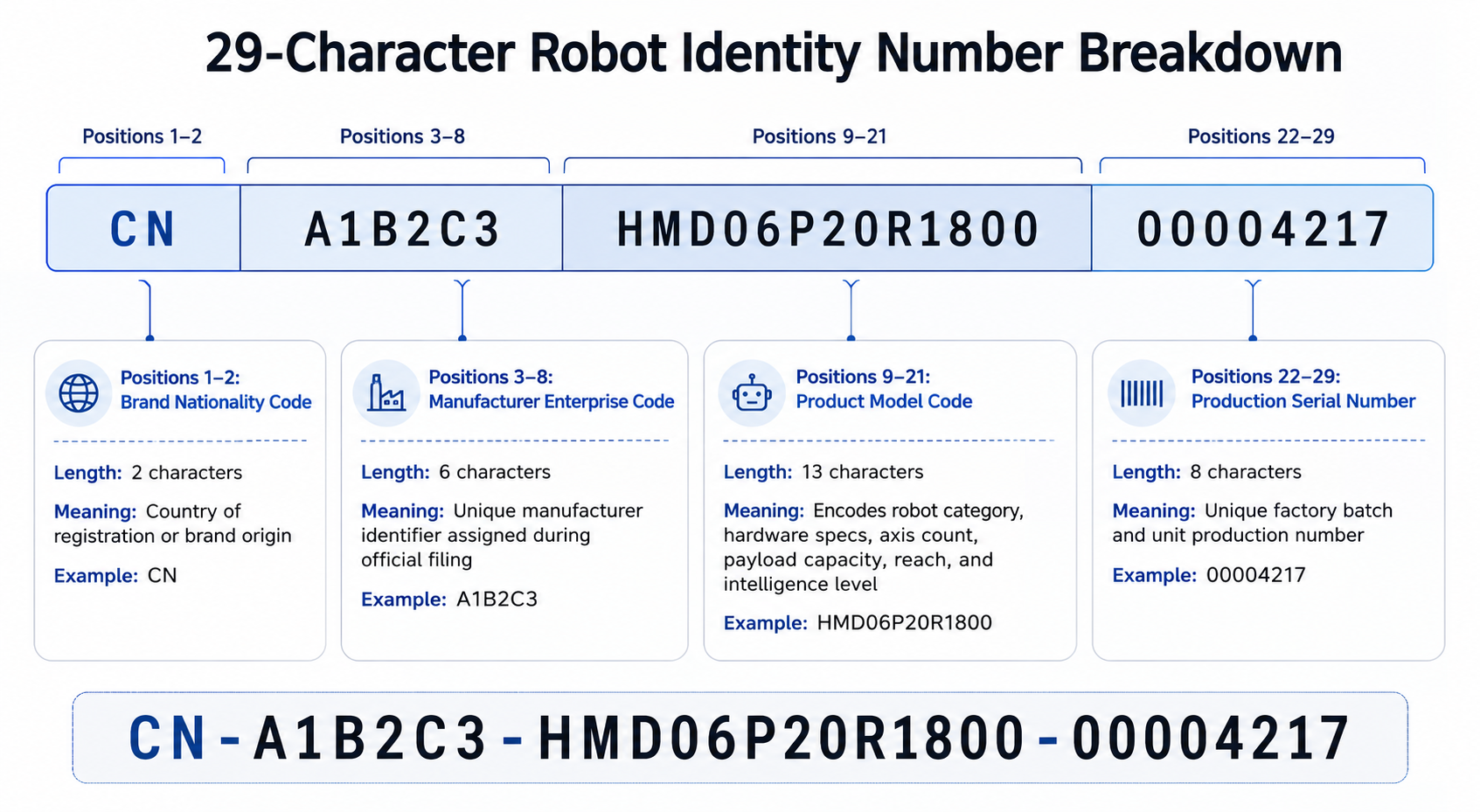
In other words: one machine, one code. At first glance, this looks like a robotics standardization story. In reality, it is part of a broader standardization push. The robot identity mechanism is connected to China's newly released Humanoid Robot and Embodied Intelligence Standard System (2026 Edition), developed under the Ministry of Industry and Information Technology's humanoid and embodied intelligence standardization structure. Public reporting describes it as China's first high-level standards framework for humanoid robots and embodied intelligence, covering the entire value chain and full lifecycle of the industry. The framework is reported to cover six major areas:
- foundational and common standards,
- brain-inspired intelligence and intelligent computing,
- limbs and components,
- complete systems and integration,
- applications, and safety
- ethics.
It also includes initiatives related to humanoid robot identity management and safe industry development.
That context matters, because i believe this is not only about giving robots a number. It is about creating the ecosystem for future, where human and non-human participants will be mixed in their roles, actions and permissions to do or not do something.
For us - it is an early signal of a new identity problem: how do enterprises identify, trace and control non-human entities operating in the physical world?
The Problem: Non-Human Entities Are Entering Sensitive Environments
For many years, enterprise security focused mainly on human identity: Employees received badges. Contractors were registered. Visitors signed in. Vendors were approved. Access control systems were built around the question: who is entering the site?
Then the problem expanded: Organizations had to manage laptops, mobile phones, cameras, sensors, IoT devices, OT assets and connected infrastructure. Security teams had to understand not only who was present, but also what devices were connected.
Now the problem is expanding again:
Factories, utilities, logistics sites, campuses, ports, hospitals and critical infrastructure environments are starting to include more mobile, autonomous and semi-autonomous systems:
- humanoid robots
- UAVs and inspection drones
- delivery robots
- autonomous carts
- robotic dogs
- temporary sensors
- mobile cameras
- smart maintenance tools
- rented industrial equipment
- third-party operational devices
These are not passive assets. Many of them can move, observe, record, transmit, interact with people, connect to cloud systems, receive commands, store data and operate near sensitive equipment. Some may act as a proxy or avatar for human, others are driven by software or AI, embedded logic or cloud-based decision making mechanism.
A robot entering a factory is not just a machine. It may carry cameras, microphones, wireless modules, local storage, APIs, cloud control, software updates, autonomous navigation and physical access to restricted areas.
That changes the security question.
It is no longer enough to ask:
Who entered the facility?
Security teams also need to ask:
What entered the facility, who owns it, what is it allowed to do, and can we trust it right now (or in future, if it here to stay)?
The Gap: Asset Tags Are Not Enough
Most organizations already have some form of asset management. They track laptops, printers, wearable equipment, servers, industrial controllers, cameras and corporate devices.
But the next generation of non-human entities creates a different problem.
Traditional asset tracking usually answers static questions:
- What is the serial number?
- Who purchased it?
- Where is it assigned?
- Is it in inventory?
That is not enough for autonomous and mobile systems.
Security teams need dynamic answers:
- Is this entity allowed to be here?
- Who is responsible for it?
- Who is operating it right now?
- What software and firmware are running?
- What sensors are active?
- What networks can it access?
- What data can it collect?
- When was it last maintained?
- Has the hardware been modified?
- Is it operating within approved boundaries?
- Should it be trusted in this specific location and context?
Without a persistent and verifiable identity, the organization cannot reliably answer these questions.
- No identity means no clear ownership.
- No ownership means weak accountability.
- No life-cycle record means no trustworthy history.
- No trustworthy history means security teams must treat every autonomous or semi-autonomous machine as an unknown actor.
That is not scalable.
Why Traceability Matters
The China Daily article frames robot identity as a way to support traceability, maintenance and liability. If a robot breaks down or causes an incident, its unique ID can help link it to operational logs, maintenance records and responsible parties.
That logic is important for public sector, but traceability should not begin after an incident. Traceability must become part of day-to-day security control, especially in sensitive areas, critical facilities or controlled environment like offices or factories.
An enterprise should be able to know, in near real time:
- which non-human entities are present
- where they are located
- what they are doing
- whether they match approved records
- whether they belong to an approved manufacturer or supplier
- whether their software and hardware match the expected profile
- whether they are behaving normally
- whether they should be blocked, isolated or challenged
This is where identity becomes operational security.
The Security Risk: Unknown Machines Become Unknown Actors
A non-human entity can create risk in several ways.
- It can be unauthorized.
- It can be legitimate but misconfigured.
- It can be compromised.
- It can be operated by a third party.
- It can contain banned or untrusted components.
- It can collect sensitive information without clear visibility.
- It can connect to networks it should not reach.
- It can enter areas where it should not operate.
- It can continue working after its trust status has changed.
For security teams, this creates a new class of identity and access management problem.
The organization needs to manage not only users and IT devices, but also physical-world actors that move across environments and interact with operations.
That requires a new layer of visibility and control, and we currently missing it.
Our View: Every Non-Human Entity Needs a Trust Profile
We believe every non-human entity operating inside a sensitive environment should have a persistent trust profile. Same as humans. This profile should not be limited to a serial number. It should combine identity, origin, ownership, configuration, behavior and operational context.
A useful trust profile should answer four basic questions:
1. Identity
What is this entity?
The system should identify the entity type, manufacturer, model, hardware characteristics, software version, communication interfaces and unique identifiers.
2. Traceability
Where did it come from and what is its history?
The organization should be able to trace supplier origin, ownership, deployment history, maintenance records, software changes, hardware modifications and previous operational contexts.
3. Permission
What is it allowed to do?
The entity should have defined permissions: where it can operate, what networks it can access, what data it can collect, what systems it can interact with and under which conditions it is approved to work.
4. Current Trust
Can we trust it right now?
Trust should not be permanent. It should be continuously evaluated based on location, behavior, configuration changes, component origin, connectivity, sensor activity and deviation from expected patterns.
The Solution: Identity, Traceability and Control for Non-Human Entities
Our solution is designed for this exact problem. We help organizations build visibility and control over non-human entities operating in your (sensitive, protected or monitored) environments.
The goal is simple:
Know what is inside your environment, understand its origin and behavior, and decide whether it should be trusted.
Our approach combines several layers:
Non-Human Entity Discovery
We identify robots, UAVs, industrial devices, mobile systems, sensors, cameras and other connected or semi-connected entities present in the environment. This creates a live map of non-human actors, not just a static asset list.
Digital Identity and Fingerprinting
We create a digital profile for each entity based on observable characteristics, identifiers, communication patterns, hardware and software signals. This allows the organization to distinguish between approved, unknown, modified and suspicious entities.
Origin and Component Traceability
We help map the entity's manufacturer, supplier, component origin, model family, hardware profile and known dependencies. This is especially important for environments where procurement, compliance, banned manufacturers, third-party risk and supply-chain exposure matter.
Operational Context
We connect identity to location and purpose. A device may be acceptable in one area but risky in another. A drone may be approved for external inspection but not for indoor operation. A maintenance robot may be allowed during a service window but not during production. Context is what turns identity into security control.
Trust and Risk Scoring
We evaluate whether the entity behaves as expected and whether its current state matches its approved profile. The system can flag deviations such as unexpected communication, unknown components, changed behavior, unusual location, outdated software or mismatch between declared and observed identity.
Control and Response
The final goal is not only to detect.
It is to support decisions.
Security and operations teams need to know whether to allow, monitor, restrict, isolate, investigate or remove a non-human entity from the environment.
Why This Matters Now
The physical world is becoming populated by connected, mobile and intelligent machines. These machines will enter factories, campuses, ports, hospitals, power sites, logistics centers and other sensitive locations.
Enterprises will need a way to manage them.
Human identity is not enough.
Device inventory is not enough.
A serial number is not enough.
The next layer of security will require identity, traceability and control over non-human entities, as well as humans enriched with technology.
The Future Access-Control Stack
The future enterprise access-control stack will combine:
- human identity
- device identity
- robot and autonomous system identity
- supplier and component origin
- location context
- operational permissions
- live behavior monitoring
- trust scoring
- response actions
A visitor badge will not be enough when the visitor is a mobile machine with sensors, autonomy and cloud connectivity. Organizations will need to verify not only people, but also machines:
- Not only who they are.
- But what they are.
- Where they came from.
- What they are allowed to do.
- And whether they can still be trusted.
Robot IDs are coming. But the bigger story is this:
Every non-human entity in the enterprise will need identity, traceability and control.
References
- China Daily - "Humanoid robots to get life-cycle tracing ID numbers" https://www.chinadaily.com.cn/a/202605/14/WS6a055d5ca310d6866eb489b0.html
- Baidu Baike - "Guidelines for the Construction of a Comprehensive Standardization System for Humanoid Robots and Embodied Intelligence" baike.baidu.com
- China SCIO - "China releases national standard system for humanoid robots and embodied intelligence" english.scio.gov.cn
- Xinhua - "China's first national standard system for humanoid robots and embodied intelligence released" english.news.cn
- Qiushi / China Daily - "China introduces a standard framework for humanoid and embodied intelligence" en.qstheory.cn